How to Make Any Recipe Your Way: Lighter, Vegan, Higher in Protein or Air-Fryer Ready
By Daniel · · 9 min read
The short answer. Change one or two things at a time, and replace what an ingredient does, not just the ingredient. Lighter: measure the oil, use Greek yogurt where you’d use sour cream, and swap half the rice or meat for vegetables or lentils. Vegan: beans, lentils or tofu for meat, a flax “egg” (1 tbsp ground flaxseed + 3 tbsp water) for an egg, plant milk for milk. More protein: Greek yogurt, legumes, lentil pasta. Gluten-free: cornstarch to thicken, tamari for soy sauce. Air fryer: about 15 °C cooler and a fifth faster than the oven. Or let Chef AI rewrite the recipe for you in Swoodie.
Most recipes are written for one person’s kitchen: their diet, their pans, their evening. Yours is different, and that’s fine. Nearly every dish can be bent toward what you need without turning into something else. This guide gives you the swaps that reliably work, the ones that don’t, and the few rules that keep a dish tasting like itself.
Three rules before you swap anything
- Change one or two things, not five. If you swap the fat, the dairy and the flour at once and the dish fails, you won’t know why. Start small, taste, then go further next time.
- Replace the job, not the ingredient. Ask what it does in the recipe. Fat carries flavour and helps browning; an egg binds or lifts; flour gives structure or thickens; sugar sweetens, browns and keeps cakes moist. A good swap does the same job.
- Cooking forgives, baking doesn’t. A stew, curry or pasta sauce will take almost any swap. Cakes and bread are chemistry: cut sugar or fat there by a little at a time, and expect a different texture.
How to make a recipe lighter
“Lighter” usually means fewer calories in the same portion. The biggest wins are rarely where people look first.
- Measure the oil. Olive oil has 884 kcal per 100 g, more than anything else in most kitchens. Recipes that say “a glug” can hide a lot of it. Use a spoon, a brush or a spray, and a non-stick pan so you need less.
- Greek yogurt instead of sour cream. Per 100 g, sour cream has 198 kcal and 2.4 g of protein; plain nonfat Greek yogurt has 59 kcal and 10.2 g of protein. Stir it in off the heat so it doesn’t split.
- Half the rice, half cauliflower. Cooked white rice has 130 kcal per 100 g, raw cauliflower 25 kcal. Mixing riced cauliflower into rice keeps the texture and lightens the plate.
- Stretch minced meat. Replace a third to a half with cooked lentils or finely chopped mushrooms. In chilli, bolognese or tacos most people don’t notice.
- Less cheese, stronger cheese. A little Parmesan or aged cheddar gives more flavour per gram than a lot of a mild cheese.
- Bake or air-fry instead of deep-frying. A light coat of oil and high heat gets you most of the crunch.
Quick swap table
| Instead of | Use | Good for |
|---|---|---|
| Sour cream, crème fraîche | Plain Greek yogurt, stirred in off the heat | Lighter, more protein |
| Part of the minced meat | Cooked lentils or chopped mushrooms | Lighter, vegetarian-leaning |
| Rice | Riced cauliflower, all or half | Lighter, low carb |
| 1 egg (to bind) | 1 tbsp ground flaxseed + 3 tbsp water, rested 5–10 minutes | Vegan |
| Milk | Unsweetened soy or oat drink, 1:1 | Vegan, dairy-free |
| Butter for frying | Olive or rapeseed oil | Vegan, dairy-free |
| Flour to thicken a sauce | Cornstarch, about half the amount | Gluten-free |
| Soy sauce | Tamari labelled gluten-free | Gluten-free |
| Regular pasta | Lentil or chickpea pasta (check the label) | More protein, often gluten-free |
| Deep-frying | Air fryer, about 15 °C cooler and a fifth faster than the oven | Lighter |
How to make a recipe vegan or vegetarian
Vegetarian drops meat and fish; vegan also drops dairy, eggs and honey. Work through the recipe one ingredient group at a time.
Meat and fish
For minced meat, use cooked brown or green lentils, crumbled firm tofu, or a mix of mushrooms and walnuts. For chunks, use chickpeas, beans, tofu or tempeh. Meat also brings savoury depth, so add it back with soy sauce, miso, tomato paste, browned mushrooms or a little smoked paprika.
Eggs
- Flax “egg”: 1 tbsp ground flaxseed + 3 tbsp water per egg, left for 5–10 minutes until it gels. It binds well in pancakes, muffins and veggie burgers.
- Aquafaba (the liquid from a can of chickpeas): about 3 tbsp per egg; it can even be whipped like egg whites.
- Mashed banana or apple purée in sweet bakes, where a little fruit flavour is welcome.
None of these makes an omelette. For a scrambled-egg dish, crumbled tofu with a pinch of turmeric is the usual answer.
Dairy
Unsweetened soy or oat drink replaces milk 1:1 in most savoury dishes and bakes. Coconut milk stands in for cream in curries and soups, and blended soaked cashews make a rich cream sauce. For a cheesy note, try nutritional yeast.
Hidden animal ingredients
Watch for fish sauce, Worcestershire sauce (usually made with anchovies), gelatine, meat stock cubes, and hard cheeses such as Parmesan, which are traditionally made with animal rennet. The label is the only reliable answer.
How to make a recipe higher in protein
- Greek yogurt, skyr or quark in sauces, dressings, dips, overnight oats and some bakes. The sour-cream swap above roughly quadruples the protein of that ingredient.
- Add a legume. A can of beans or lentils in a soup, stew or salad adds protein and fibre at once.
- Swap the pasta for lentil or chickpea pasta, or toss cooked chicken, prawns, tofu or an egg through a grain bowl.
- Blend cottage cheese into a sauce for a creamy, higher-protein pasta.
- Careful with protein powder in baking. It dries cakes out; in oats and pancakes it works better.
How much protein you need depends on you; our guide on how much protein to eat to build muscle walks through it.
Gluten-free and dairy-free swaps
- Thicken without flour: cornstarch at about half the amount of flour, mixed with a little cold water first.
- Swap the base: rice, potatoes, quinoa, buckwheat (gluten-free despite the name) or gluten-free pasta. Oats are only safe when labelled gluten-free.
- Check the sauces: regular soy sauce contains wheat; use tamari labelled gluten-free. Stock cubes, spice mixes and ready sauces often contain wheat or milk too.
- Baking: use a gluten-free flour blend made for 1:1 swaps; plain rice flour alone makes cakes crumbly.
Cooking for someone with coeliac disease or a food allergy? The swap is only half the job. Read every label, and keep their food apart from crumbs, shared boards and shared fryer oil.
Low-carb swaps
Cauliflower rice or mash for rice and potatoes, courgette ribbons for pasta, lettuce leaves for wraps, and a sauce reduced until thick instead of one thickened with flour. Keep the sauce and the seasoning, and the dish still tastes like itself.
How to convert a recipe for your kitchen
Oven to air fryer
As a rule of thumb, an air fryer runs about 15 °C cooler and a fifth faster than an oven. So 200 °C for 25 minutes in the oven becomes about 185 °C for about 20 minutes. Don’t crowd the basket, shake or flip halfway, and check early. Our free air fryer converter does the arithmetic.
Everything in one pan
Start with what takes longest (raw meat, dense vegetables like potatoes and carrots), then add the quick things (peppers, spinach, prawns) near the end. Pasta and rice can cook right in the sauce if you add more liquid.
Slow cooker
Almost nothing evaporates under the lid, so start with about a third less liquid than a stovetop recipe. Add dairy, fresh herbs and quick-cooking vegetables in the last half hour, and thaw meat before it goes in.
Microwave
Cut everything to a similar size, cover loosely, stir halfway, and let the dish stand for a minute or two before you eat: it keeps cooking.
Cook from what’s already in your fridge
Most ingredients have stand-ins from the same family. Swap one leafy green for another, one bean for another, leek or shallot for onion, lime or vinegar for lemon, any hard cheese for any other. Keep the method and change the parts: a stir-fry, a frittata, a soup or a pasta sauce will take almost anything. And if the recipe serves six and you are two, our recipe scaler resizes it.
The shortcut: let Chef AI rewrite the recipe in Swoodie
Everything above works with a pen and some tasting. If you’d rather skip the arithmetic, Swoodie does the rewrite for you. Open a recipe and tap Variation.
- Pick a style. The picker sorts them into four tabs, Health, Diet, Kitchen and Everyday, with a Recommended for you row on top that says why: it fits your goal, matches your diet, fits the calories you have left today, or uses what’s in your pantry.
- Chef AI writes a new version of the recipe, with its own calories and macros. Like every calorie figure, they are estimates.
- The original stays. Nothing is overwritten, so you can compare the two or go back.
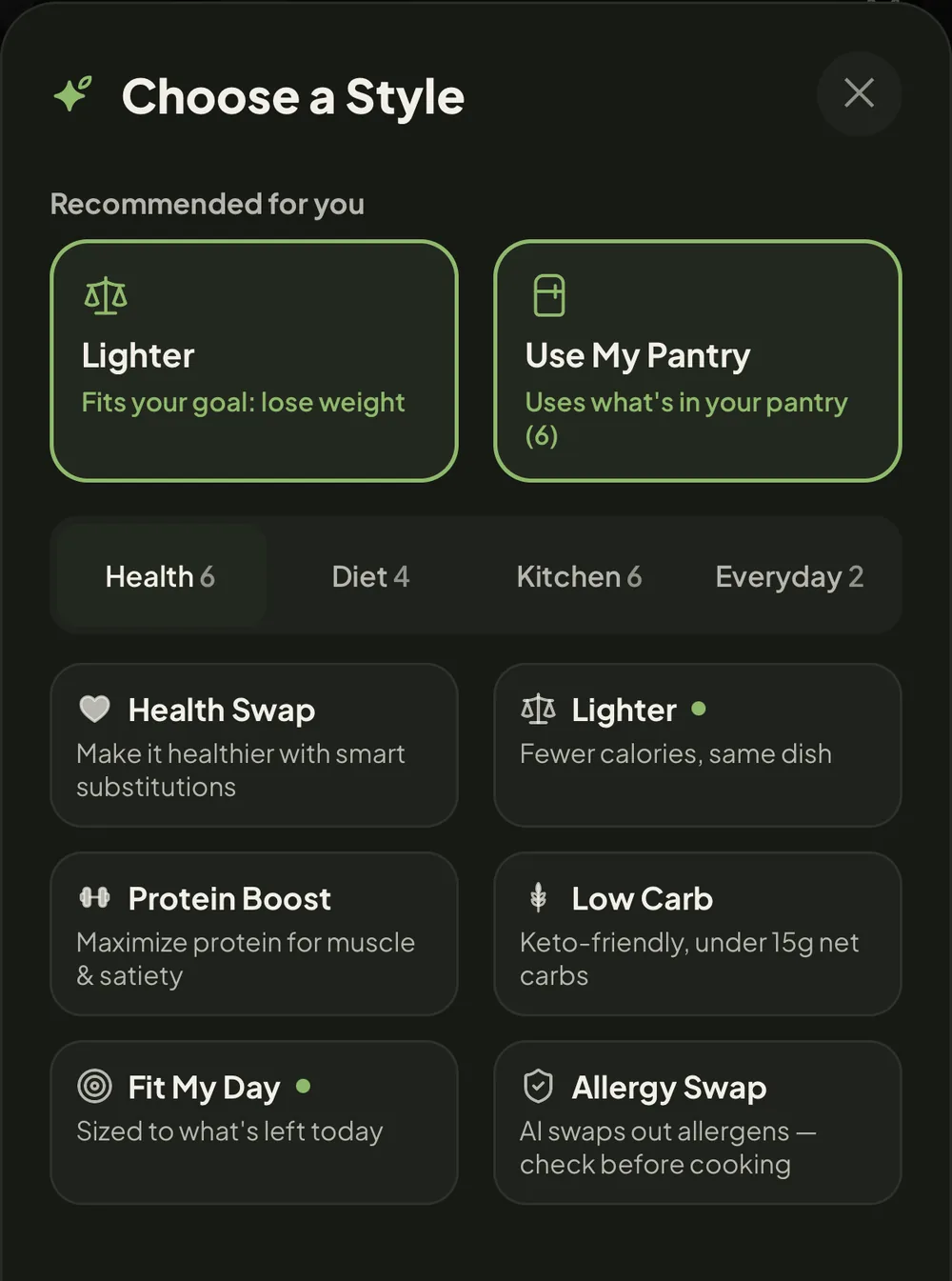
Every swap from this guide has a style:
- Lighter (“Fewer calories, same dish”), Protein Boost, Low Carb and Health Swap.
- Diet Swap: Vegan, Vegetarian, Pescatarian, Gluten-free, Dairy-free or Keto.
- Your Equipment: Air fryer, One pan, Slow cooker or Microwave.
- Fit My Day (“Sized to what’s left today”): the new version is sized to the calories and protein left in your day.
- Use My Pantry (“Built from what you already have”): built from the items in your Swoodie pantry, so add a few there first.
- And for everyday cooking: 5 Ingredients, Quick Version, Budget Friendly, Spice It Up, Cultural Twist, Meal Prep (4–5 portions for the week), Make it Lunchbox and Make it for Kids.
About allergies: there is an Allergy Swap style, and its card says it plainly: “AI swaps out allergens — check before cooking”. Treat the new version as a first draft and read every ingredient and label yourself before you cook it for someone with an allergy.
Variation is part of Swoodie Premium. New to Swoodie? Premium is free for 7 days on the yearly plan, so you can try it on your own recipes first.
New to cooking? Start with how to start cooking and the most common beginner mistakes. Counting what you cook? See how to count calories in a home-cooked dish.
Free to start — no account, no card, no ads. Get Swoodie on iOS or Google Play.
Frequently asked questions
How do I make a recipe healthier without ruining it?
Change one or two things at a time, and replace what an ingredient does, not just the ingredient. The easiest wins: measure the oil, use Greek yogurt instead of sour cream, swap part of the rice for cauliflower and part of the minced meat for lentils or mushrooms, and bake or air-fry instead of deep-frying.
What can I use instead of an egg in a recipe?
To bind, use a flax egg: 1 tablespoon of ground flaxseed and 3 tablespoons of water, left for 5–10 minutes until it gels. About 3 tablespoons of aquafaba (the liquid from a can of chickpeas) also replace one egg, and mashed banana or apple purée work in sweet bakes. None of them makes an omelette.
How do I add more protein to a recipe?
Use Greek yogurt, skyr or quark in sauces and dips (per 100 g, plain nonfat Greek yogurt has 10.2 g of protein, sour cream 2.4 g), add beans or lentils, switch to lentil or chickpea pasta, or blend cottage cheese into a pasta sauce.
How do I convert an oven recipe for an air fryer?
As a rule of thumb, an air fryer runs about 15 °C cooler and a fifth faster than an oven: 200 °C for 25 minutes becomes about 185 °C for about 20 minutes. Don't crowd the basket, shake or flip halfway, and check early.
Can Swoodie change a recipe for me?
Yes. Tap Variation on a recipe and pick a style such as Lighter, Protein Boost, Diet Swap (vegan, vegetarian, gluten-free and more), Your Equipment (air fryer, one pan, slow cooker, microwave) or Fit My Day. Chef AI writes a new version with its own estimated calories and macros, and the original stays. The Allergy Swap card itself says to check before cooking, so always read the ingredients yourself. Variation is part of Premium, which is free for 7 days on the yearly plan.
Written by
Daniel
Founder of Swoodie
Hi, I'm Daniel — the person behind Swoodie. I'm based in Poland and have been working on Swoodie solo since January 2026. I write about nutrition tracking, intermittent fasting, recipe planning, and cooking together with a partner — everything tested in my own kitchen with the app I'm building.
Related articles
Macros
How to Count Calories and Macros in a Home-Cooked Dish: Weigh the Pot, Then Your Plate
A worked example with real numbers: add up the raw ingredients, weigh the finished pot, weigh your plate and take its share. Plus the 4/4/9 check and the kJ trap on EU labels.
· 7 min readMeal prep
Samsung Food vs Paprika vs Swoodie (2026): Free Giant, Classic Vault, or All-in-One?
An honest 2026 comparison of Samsung Food, Paprika, and Swoodie — recipe library, meal planning, calorie tracking, price, and vendor lock-in. Which recipe app fits how you actually cook?
· 8 min readMeal prep
Free 7-Day Diet Meal Plans: Keto, High-Protein, Paleo & More (2026)
A free guide to ready-made 7-day diet meal plans — keto, high-protein, vegan, Mediterranean, paleo and more — how to use one, and how to tweak it to taste and auto-build a shopping list.
· 7 min readMeal prep
How to Save Recipes from TikTok, Instagram & YouTube (2026)
Saved a recipe video you can't find again? How to save recipes from TikTok, Instagram and YouTube — and turn any link into ingredients, steps and tracked macros.
· 7 min read