How Much Protein to Build Muscle in 2026 (A Practical Guide)
By Daniel · · 8 min read
If you train to build muscle, protein is the one number worth getting right. Not because the other macros don’t matter — they do — but because protein is the input most people get wrong, usually by eating far less than they think. The good news: the target is simple, and you don’t need to weigh every meal to hit it.
This is a practical guide to how much protein actually builds muscle in 2026, how to spread it through the day, where to get it, and how to keep track without turning every dinner into a maths problem.
How much protein do you actually need?
For building muscle, the evidence keeps landing in the same place: 1.6 to 2.2 g of protein per kg of body weight per day (roughly 0.7 to 1.0 g per lb). Most people do well aiming for the middle of that range — about 1.8 g/kg — and going higher mainly helps when you’re in a calorie deficit and trying to hold onto muscle while you lean out.
A few quick examples of a daily target at 1.8 g/kg:
- 60 kg (132 lb) → ~108 g protein/day
- 75 kg (165 lb) → ~135 g protein/day
- 90 kg (198 lb) → ~162 g protein/day
If you’re carrying a lot of body fat, base the number on your target or lean body weight rather than total weight, so you’re not chasing an unrealistically high figure. Don’t want to do the maths? The free protein calculator turns your weight and goal into a daily target in a couple of taps.
Spread it across the day, don’t cram it
Your body builds muscle better from protein spread across the day than from one giant dinner. The practical rule: aim for 3 to 4 meals with 30 to 50 g of protein each, spaced a few hours apart. That’s enough to keep muscle protein synthesis topped up without obsessing over timing.
The old “anabolic window” panic — that you must slam a shake within 30 minutes of training — is largely overblown. What matters far more is your total for the day and that you eat a solid protein meal within a few hours either side of your workout.
The best protein sources
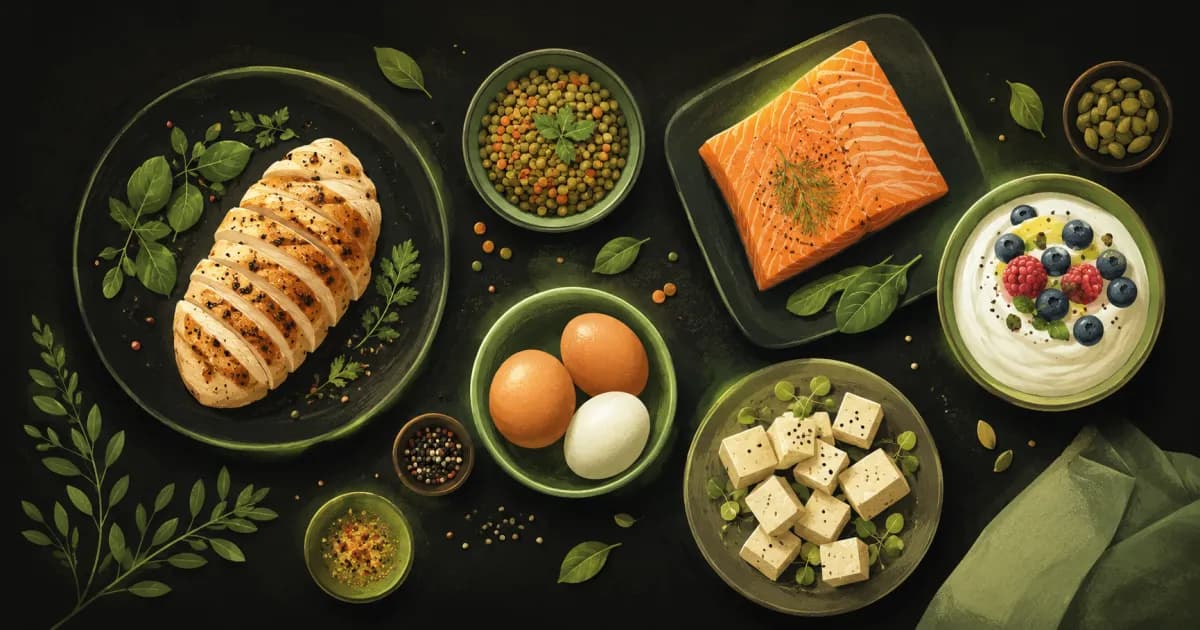
You want sources that are high in protein per calorie and rich in the amino acids muscle is built from. Rough protein per typical serving:
- Chicken breast — ~31 g per 100 g cooked
- Lean beef / pork — ~26–28 g per 100 g
- Fish (salmon, cod, tuna) — ~22–26 g per 100 g
- Eggs — ~6 g each
- Greek yogurt / skyr — ~10 g per 100 g
- Cottage cheese — ~11 g per 100 g
- Lentils & beans — ~8–9 g per 100 g cooked
- Tofu / tempeh — ~12–19 g per 100 g
- Whey or plant protein powder — ~20–25 g per scoop
Plant-based? You can absolutely build muscle without meat — just lean on a variety of sources (soy, legumes, grains) and aim a little higher on total intake, since plant proteins are slightly less efficient gram-for-gram. See the vegan nutrition guide for more.
Protein builds muscle — calories decide if it shows
Protein is the raw material, but muscle growth still needs energy. To build size, most people need a small calorie surplus — around 200–400 kcal above maintenance. To build muscle while losing fat (a “recomp”, realistic mostly for beginners or those returning to training), stay near maintenance and keep protein high.
Find your maintenance level first with the free TDEE calculator, then layer your protein target on top. If you’re cutting instead, the calorie deficit calculator gives you the daily number to lose fat while you protect muscle with a high-protein intake.
Simple high-protein meal prep
Hitting 130–160 g a day sounds like a lot until you build it into a routine. A no-stress template:
- Breakfast: Greek yogurt with berries and a scoop of protein, or 3 eggs with oats — ~30–40 g.
- Lunch: a palm-and-a-half of chicken, fish, or tofu with rice and veg — ~40 g.
- Dinner: lean meat or legumes with potatoes or pasta — ~40 g.
- Snack: cottage cheese, a shake, or skyr — ~20–30 g.
Batch-cook a protein source or two on the weekend and the daily target stops being a decision you have to make four times a day. The meal-prep guide covers how to plan a week of this in one session, and the recipe scaler helps you cook for the week from a single recipe.
Track it without weighing everything
You don’t need a food scale on the counter forever. Two habits get you most of the way:
- Learn a handful of portions. A palm of meat is ~25–30 g protein; a fist of yogurt or cottage cheese is ~10–15 g. Once you know five or six of these, you can eyeball a day.
- Snap, don’t spreadsheet. Logging by photo or by describing a meal in a sentence is far more sustainable than typing grams into a database. Prefer to enter it yourself? Quick Add is the free way to log protein and calories by hand in a couple of taps. The whole point is to hit your number on most days, not to be perfect on any one day.
That second habit is exactly how Swoodie’s muscle-gain setup works — point your camera at a plate or scan a barcode and it logs calories and protein in seconds, so you can see whether you actually hit your target instead of guessing.
In Swoodie, pick the free high-protein target and it sets your daily protein/carb/fat split automatically — then log by photo and watch the protein number tick toward it.
The short version
- Aim for ~1.6–2.2 g protein per kg body weight per day.
- Spread it over 3–4 meals of 30–50 g.
- Eat a small calorie surplus to grow; stay near maintenance to recomp.
- Pick high-protein staples and batch-cook them.
- Track by photo and learned portions, not by weighing everything.
Building muscle comes down to repetition: decide what to cook, hit your protein, and check you got there. Swoodie closes all three in one place — pull a high-protein recipe or let Chef AI write one around what you have, set the free high-protein target, then log by photo so your daily protein total is always one glance away.
This is general nutrition information for healthy adults, not medical advice. If you have a medical condition or train at a high level, check your plan with a registered dietitian or doctor. Try Swoodie free on iOS or Google Play — no account needed.
Written by
Daniel
Founder of Swoodie
Hi, I'm Daniel — the person behind Swoodie. I'm based in Poland and have been working on Swoodie solo since January 2026. I write about nutrition tracking, intermittent fasting, recipe planning, and cooking together with a partner — everything tested in my own kitchen with the app I'm building.
Related articles
Samsung Food vs Paprika vs Swoodie (2026): Free, Buy-Once, or All-in-One?
8 min read
An honest 2026 comparison of Samsung Food, Paprika, and Swoodie — recipe library, meal planning, calorie tracking, price, and vendor lock-in. Which recipe app fits how you actually cook?
Free 7-Day Diet Meal Plans: Keto, High-Protein, Paleo & More (2026)
7 min read
A free guide to ready-made 7-day diet meal plans — keto, high-protein, vegan, Mediterranean, paleo and more — how to use one, and how to tweak it to taste and auto-build a shopping list.
How to Save Recipes from TikTok, Instagram & YouTube (2026)
7 min read
Saved a recipe video you can't find again? How to save recipes from TikTok, Instagram and YouTube — and turn any link into ingredients, steps and tracked macros.
Best Recipe Manager Apps in 2026: Paprika vs ReciMe vs Crouton vs Pestle vs Swoodie
9 min read
An honest roundup of the best recipe manager and organizer apps for 2026 — Paprika, ReciMe, Crouton, Pestle and Swoodie — compared on importing, meal planning, pricing, and which one also tracks what you actually eat.