Intermittent Fasting with a Partner: The Complete 2026 Guide
By Daniel · · 8 min read

Intermittent fasting is one of those habits that looks simple on a screenshot and turns out to be a relationship project in practice. The eating window is the easy part. The hard part is doing it next to another person whose hunger, schedule and patience are not on the same clock as yours.
Most people who start IF on their own quit within two weeks. The dropout rate drops sharply when someone else is on the same schedule. So this guide is about the parts the app screenshots leave out: how to pick a protocol you can both stick to, how to actually sync the window, what to do when one of you cracks at 11am, and how to make breaking the fast a small ritual instead of another debate.
Pick a protocol you can both commit to
The biggest mistake couples make is picking the most aggressive protocol that fits one partner’s lifestyle. If one of you can comfortably skip breakfast and the other gets a headache by 10am, 16:8 in week one is not a shared protocol; it is one person fasting and one person suffering.
A safer staircase: start at 12:12 for week one (eat 12 hours, fast 12 hours). That is basically “no snacking after dinner.” Move to 14:10 in week two if you both feel fine. Move to 16:8 in week three or four if 14:10 still feels easy. OMAD (one meal a day) is not a starter protocol; it ships with a “talk to a professional” caution in most apps for a reason. Treat it as a long-term option, not a week-two goal.
The rule is simple. Pick the protocol the more cautious partner can hold, not the one the more enthusiastic partner wants to brag about.
Sync your eating window literally
Both people eating in the same window matters more than the duration. If one of you breaks the fast at 11am and the other at noon, the “we are doing this together” story breaks down inside a week. You are no longer fasting together. You are two people on parallel diets who happen to live in the same house.
The fix is alignment, not flexibility. Agree on one start time and one end time for the fasting window, and hold both. If your shared window is 8pm to noon, that is the window for both of you. Not 11am for the early riser and 1pm for the late riser. If the difference is forty-five minutes on a workday morning, narrow it to fifteen and converge over a week.
The tools for fasting together
You essentially have three options.
- Manual. A shared note and a phone alarm. Free, low-tech, works if you are both organized. The friction shows up the first time someone forgets to flip the alarm on a weekend.
- Two separate trackers. One of you on Zero, the other on Fastic. Both apps will time you accurately. Neither knows the other exists, which means “synced” means “we both set 16:8 and hoped for the best.”
- One app, two visible fasts. Swoodie’s Fast Together pairs the two of you with an invite code. You each still set your own protocol — the app will not impose a window on either of you — but each of you can then see the other’s fast running live: which protocol they picked, when they started, how many hours in they are. You can send encouragement while they are still in it. Hosting is Lite or Premium; joining is free.
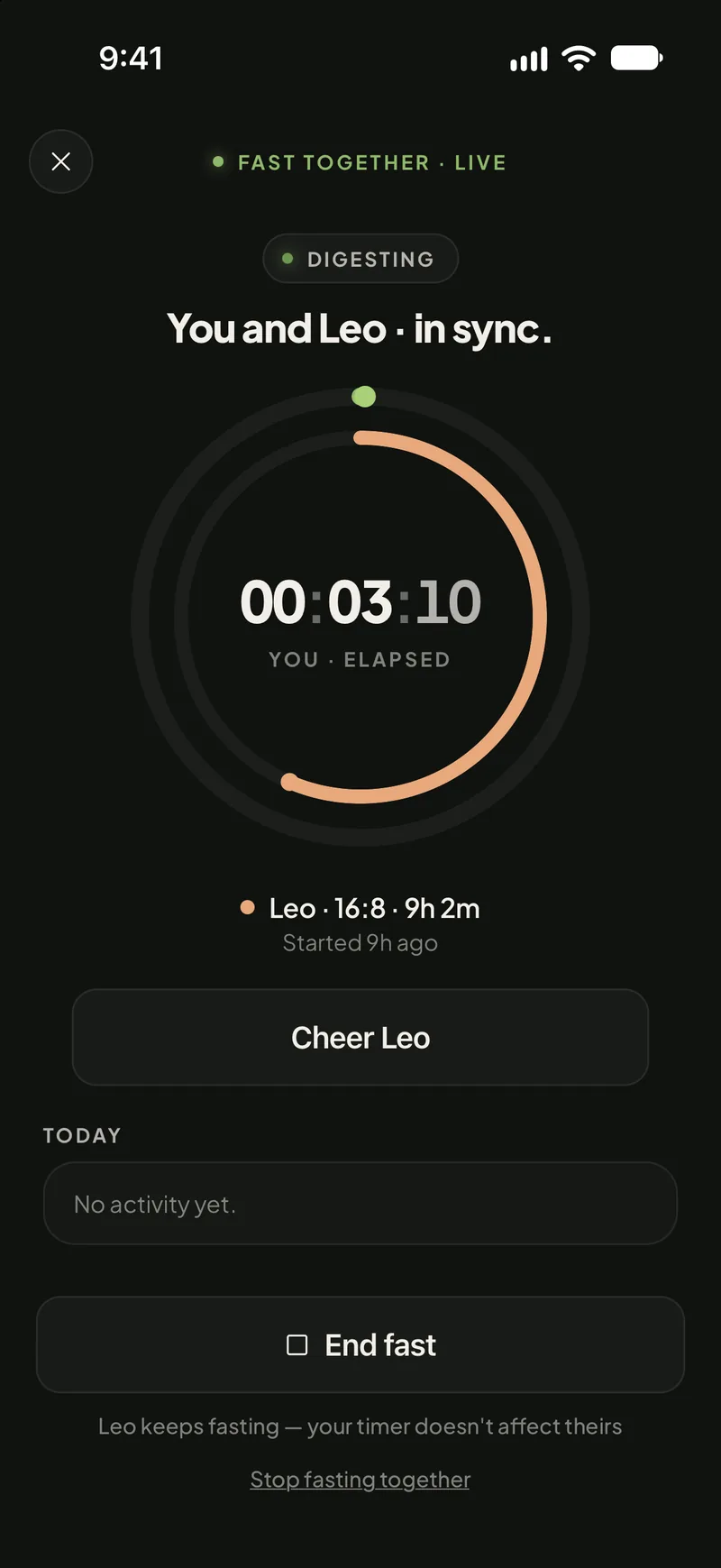
None of the three is wrong. Agreeing on the window is your job in all three of them; the difference is whether you can see how the other person is doing inside it. That is the friction the third option removes — nobody has to ask “are you still fasting?” at 11am. If you and your partner already share calendars, photos and a grocery list, seeing each other’s fast is the same idea.
Handle different schedules
One night owl plus one early bird is the common version. So is one office shift plus one evening shift. Three strategies that actually work:
- Pick the latest common eating window. Both eat at the time the late riser would anyway. The early riser fasts a little longer in the morning; nobody is forced to eat at 7am.
- Alternate weekly. You set the schedule one week, your partner the next. Useful when neither lifestyle is the “default.”
- Sync on weekends, accept asynchronous fasting on weekdays. Two synced days are better than zero. Saturdays and Sundays are when fasting together actually feels like a shared activity (breakfast, walks, the late lunch).
The hunger waves: when one of you cracks
Hunger comes in waves, not a steady line. Each wave usually peaks in fifteen to thirty minutes and then passes if you do nothing. The tactical sequence that helps both partners get through one:
- Drink water first. A surprising amount of “hunger” in the first week is dehydration.
- Send a message to your partner. A 👏 or a one-line check-in resets the brain.
- Change the task. Stand up, walk to another room, start something with hands in it. The wave is much shorter when you are doing something else.
- If you cracked, say so out loud. A clean “I broke at 11:40, finishing the window tomorrow” is better than hiding it. Hidden cracks erode the shared habit faster than the cracks themselves.
A coach helps too. Apps like Simple and Swoodie (with Ollie’s Fasting Coach) drop in small nudges inside the window. Whether you find them useful or noisy is personal; if you do find them useful, having the same coach voice on both phones is one less small inconsistency.
Break the fast together as a ritual
A small shared moment when the window opens matters more than what you eat. Coffee at the same table. A simple breakfast you both like. Two minutes of “how did that one go” before the day picks up. The fasting window is the part most apps measure; the break is the part most couples remember.
The fastest way to ruin the ritual is to start every break-fast with “so what should we eat?” Decide the night before. Use a meal planner. If you are already on a couples app like Swoodie, Swipe Together turns the dinner decision into a three-minute swipe match instead of a forty-minute scroll.
Track without obsessing
Pick one metric and track only that. Longest streak. Window adherence. Weight if you must. Not all three. Obsessive tracking is the second biggest predictor of dropout after picking too-aggressive a protocol; couples who weigh themselves daily and compare numbers usually quit before couples who weigh weekly and barely talk about it.
The point of the tracker is to keep you honest about whether you did the thing, not to turn a habit into a leaderboard. One number per partner per week is plenty.
Common pitfalls
- Going from zero to 16:8 in week one. Almost guaranteed to end with one of you quitting before week three.
- Different windows on weekdays. “Close enough” is not synced. Pick one window and converge.
- Coffee with milk arguments. Some apps say it breaks the fast; others say it doesn’t. Pick a house rule and stop relitigating it every morning.
- Treating a missed day as failure. One missed day in seven is fine. The metric that matters is the pattern across the month, not any single fast.
- Hiding from each other when you cracked. The shared habit dies the second one of you starts pretending.
A 30-day starter plan
The point of this month is not to lose weight. The point is to find out whether IF works for both of you.
- Week 1: 12:12 together. Same start, same end. No snacks after dinner. Notice how it feels.
- Week 2: 13:11 or 14:10. Push the breakfast back by an hour or two. Hold the dinner cutoff steady.
- Week 3: 14:10 or 16:8. Based on how week 2 felt for the more cautious partner, not the more enthusiastic one.
- Week 4: hold steady. Whatever protocol you both held through week 3 is your real starting point. No social-media announcement. Just see if it sticks for another month.
Deeper reading
Comparison of the dedicated fasting trackers: Zero vs Fastic vs Swoodie. Wider fasting + wellness comparison: Yazio vs Lifesum vs Simple vs Swoodie. The use-case page: intermittent fasting with Swoodie. One-on-one breakdown of the closest single competitor: Swoodie vs Fastic.
Try Swoodie free on iOS or Google Play — no account needed; your first five fasts are free, Fast Together hosting is Lite or Premium, joining is free.
Frequently asked questions
Can I do intermittent fasting with my partner if we have different schedules?
Yes, but pick a strategy upfront. Three options: align on the latest common eating window (both eat at the time the late riser would anyway), alternate weeks (you set the schedule one week, your partner the next), or sync only on weekends. Swoodie's Fast Together never imposes a window — you each keep your own protocol and simply see the other's fast running live — so you can line up on the days you choose and go your own way on the rest.
What's the best fasting protocol to start with as a couple?
12:12 for the first week, even if both of you think you can handle 16:8. The hardest part of intermittent fasting isn't the fast itself — it's making it sustainable for both partners. Starting at 12:12 (eat 12 hours, fast 12 hours) is basically 'don't snack after dinner.' Move to 14:10 in week 2 if you both feel fine, then 16:8 in week 3-4. OMAD (one meal a day) is not a starter protocol; it ships with a 'talk to a professional' caution in most apps for a reason.
Do we need the same app to fast together?
No, but it helps. You can manually align windows with any tracker (Zero, Fastic, Yazio, Lifesum all have IF timers). The advantage of a single app that links the two of you — Swoodie's Fast Together does exactly that — is that you see each other's fast in real time and can send encouragement when one of you hits a hunger wave. Without that link, you are each timing a fast the other person cannot see.
Written by
Daniel
Founder of Swoodie
Hi, I'm Daniel — the person behind Swoodie. I'm based in Poland and have been working on Swoodie solo since January 2026. I write about nutrition tracking, intermittent fasting, recipe planning, and cooking together with a partner — everything tested in my own kitchen with the app I'm building.
Related articles
Zero vs Fastic vs Swoodie 2026: The Best Intermittent Fasting Apps Compared
8 min read
Zero, Fastic and Swoodie compared in 2026: free tier, protocols, partner features, recipes and pricing. Which intermittent fasting app actually fits your week?
Paprika vs Mela vs Crouton vs Swoodie 2026: The Best Recipe Manager App?
8 min read
Paprika, Mela, and Crouton are the best-loved recipe managers of 2026 — beautiful, one-time-ish, and built to file recipes you find. Here's how they compare, and where Swoodie's recipes-plus-tracking model fits.
Noom vs WeightWatchers vs Swoodie 2026: Which Weight-Loss App Is Worth It?
9 min read
Noom, WeightWatchers, and Swoodie compared in 2026: real prices, Points vs macros, AI photo scanning, coaching, recipes, and couples features. Honest verdict by use case.
A Day with Swoodie: How One App Handles Dinner, Tracking & Eating Together
7 min read
A walk through an ordinary day with Swoodie — logging meals by photo, deciding dinner together, cooking from what's in your fridge, and keeping your goals on track without juggling five apps.