AI Calorie Counter Apps in 2026: How Photo Scanning Actually Works
By Daniel · · 6 min read
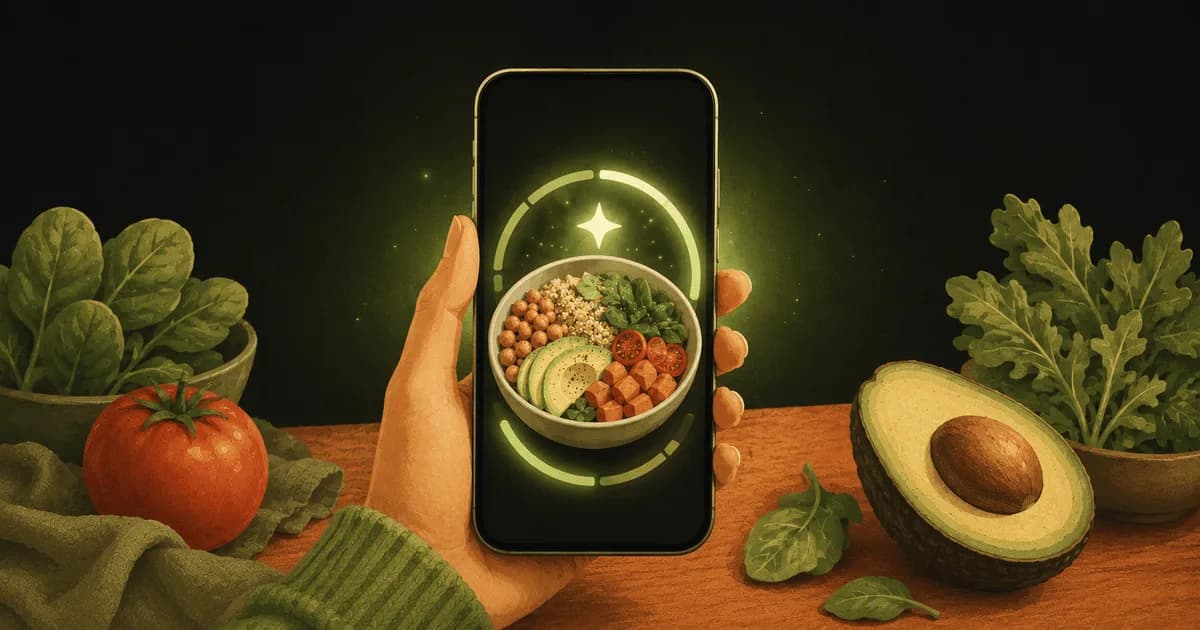
The old way to count calories was tedious: search a database, find your food, estimate the portion, type the grams, repeat for every ingredient. AI calorie counter apps in 2026 skip most of that. Point a camera at your plate or scan a barcode, and you get calories, macros, and a health score in seconds.
But not all AI calorie counters work the same way. Here’s how to tell which ones are accurate enough to actually rely on.
What does an AI calorie counter actually do?
An AI calorie counter uses computer vision to identify the foods on your plate (or read a packaged-food barcode) and estimate the nutrition without you typing anything. The good apps combine three modes:
- Photo scan — Your phone’s camera + a food-recognition model identifies ingredients and portion sizes from a meal photo.
- Barcode scan — For packaged food, the app looks up the product in verified global product databases — far more accurate than a photo estimate.
- Text-to-nutrition — Type “two slices of sourdough toast with avocado and an egg” and the AI parses ingredients, portions, and macros.
How accurate is a photo-based calorie tracker?
AI nutrition estimates from photos are typically within 10–20% of the real values for common foods, and less accurate for unusual portions, dense mixed dishes, or fried items where oil is invisible.
For day-to-day tracking and trends, that’s plenty. For medical or therapeutic nutrition (clinical weight loss, sports performance targets, diabetes management), you should verify with a dietitian or use weighed entries.
A useful rule of thumb: trust barcode scans more than photo estimates. Trust the photo estimate more for whole-food plates than for mixed sauces and casseroles where the AI can’t see what’s inside.
What to look for in an AI calorie tracker
- Three input modes, not one. Photo, barcode, and text-to-nutrition each have different strengths. An app with all three is dramatically more useful than a photo-only tool.
- Allergen detection. A good food scanner flags common allergens (gluten, dairy, nuts, soy) automatically.
- Personalized targets, not generic ones. Look for apps that auto-calculate your BMR/TDEE based on your goals (cut, maintain, bulk) instead of dumping a flat 2000-calorie target on everyone.
- Privacy. Photos of your meals say a lot about you. Prefer apps that process scans in real-time without permanent storage, and don’t require an account to start.
- Free tier that’s genuinely usable. Free should let you actually evaluate the AI — not a 3-scan limit that forces an immediate upgrade.
Tracking macros without a kitchen scale
The most common reason people quit calorie tracking: weighing every ingredient is exhausting. A modern AI calorie counter sidesteps the scale entirely:
- For prepared meals, snap a photo and the AI estimates portions visually.
- For packaged food, the barcode tells you the exact nutrition per 100g; you only need to estimate how much you ate of the package.
- For recipes you cook, log the recipe once and the app handles per-serving math forever after.
How Swoodie does it
Swoodie is built around all three input modes in one app. Swoodie Scan handles photo + barcode (and if a product isn’t listed, you can snap its nutrition label instead). Text-to-Nutrition handles plain-language logging. Everything feeds a daily dashboard with calories, macros, allergens (including gluten), and a 0–100 health score — tied to personalized BMR/TDEE targets you set once.
You get 10 free one-time AI uses on the free tier, no account required. Photos are processed in real time and never permanently stored.
Compare specific AI photo counters: Cal AI vs Foodvisor vs Swoodie, or wellness-focused trackers in Yazio vs Lifesum vs Simple vs Swoodie.
Download Swoodie on iOS or Google Play to try the AI calorie counter on your own meals.
Written by
Daniel
Founder of Swoodie
Hi, I'm Daniel — the person behind Swoodie. I'm based in Poland and have been working on Swoodie solo since January 2026. I write about nutrition tracking, intermittent fasting, recipe planning, and cooking together with a partner — everything tested in my own kitchen with the app I'm building.
Related articles
Lose It! vs MacroFactor vs Swoodie 2026: Which Calorie Tracker Is Worth It?
8 min read
Lose It!, MacroFactor, and Swoodie compared in 2026: free tiers, adaptive macro coaching, AI photo logging, recipes, meal planning, and real prices. Honest verdict by use case.
MyFitnessPal vs Yazio vs Swoodie 2026: Free Tiers, AI Scan & Real Prices
8 min read
What MyFitnessPal Premium really costs, what Yazio gives you free vs Pro, and where Swoodie fits: real prices, free tiers and AI photo scans, side by side.
Cal AI vs Foodvisor vs Swoodie 2026: AI Photo Calorie Counter Comparison
8 min read
Is Cal AI or Foodvisor free, what does each really cost, and how accurate are the photo scans? Compared with Swoodie: 10 free AI uses, no card.
Carb Manager vs Cronometer vs Swoodie (2026): Keto, Precision, or All-in-One?
8 min read
Side-by-side comparison of Carb Manager, Cronometer, and Swoodie in 2026 for keto dieters and macro trackers. Features, accuracy, meal planning, and pricing compared.